Sunday, April 14, 2024

Relativity, IUCAA and Cambridge : Recalling the beginning of my love for Theoretical Physics

 It was a very usual evening on the 16th of February. I was waiting in queue at a bustling petrol pump to refill my bike with fuel. Everyday used to be a generous dose of anxiety for me as I was anticipating for decisions from the universities that I have applied to. There were a few heartbreaking rejections, but I was still in hope, awaiting a decision from my top choice. In the queue, I was resisting the compulsive urge to check my e-mails and refresh the application portal - the habit was mentally exhausting but with each e-mail refresh and portal login, I held in a small hope of receiving a positive response. Eventually, I succumbed to the urge once again and opened my email inbox with complete unpreparedness of seeing any update. What were the odds after all that I will receive the good news at a petrol station?! Turns out, I was utterly wrong! There was an email with the subject line - "University of Cambridge - Conditional Offer of Admission". Completely taken aback by this email, I opened it and there it was - an offer from the University of Cambridge to study for the Master of Advanced Studies (MASt) in Theoretical Physics course. In those few minutes, while the "emotions" department of my brain was still processing the news, the "memories" department decided to play a quick recap of my journey so far. 

The University of Cambridge
Image Credit : University of Cambridge


The desire to study at the prestigious University of Cambridge was not new for me and it certainly was not inspired by Hogwarts (I have not even watched the Harry Potter movies). In fact, it was sparked when I was in the 8th grade, when my interests transitioned from rockets and space exploration to astrophysics and relativity. The transition was inspired by a set of biographies titled - "Genius" written by a Marathi businessman and writer named Achyut Godbole. The biographies were given to me by my mother as a "gift". Eventually, the books got me hooked even though they were entirely written in the Marathi language in which my comprehension skills were somewhat limited. The first ever book that I picked up from the set was of "Albert Einstein". The life of a seemingly ordinary child growing up to be an extraordinary genius resonated with me at the time and served as a good fantasy for my innocent self. But that is not what struck me the most in that book. Throughout my schooling, I had a bitter-sweet relationship with Mathematics. A subject which I found really hard to tame and master unlike my other favorites - Physics, Biology and Chemistry (the last one unfortunately fell out of the list in due course, thanks to the abomination named Organic Chemistry). I can still vividly recall a small paragraph of the book which attempted at explaining Einstein's Special Theory of Relativity to the layman. Well, not the entire theory but a small and popular consequence of it that we call - "time dilation". The time dilation which is responsible for the apparent slowing of clocks in a moving frame of reference as observed by someone who is in a stationary frame of reference relative to the first. At the end of that paragraph stood the mathematical equation for time dilation - 

It is fairly easy to understand and holds no deeper meaning than what the theory specifies. However, at that time I was deeply fascinated by it. As I tried to connect my existing mathematical knowledge with the interpretation of that equation, I ventured straight into its limiting case - "What happens if v is equal to c?" - I asked myself. In the blink of an eye, the answer was apparent - "The denominator becomes zero, and t' becomes infinite. Therefore, the stationary observer measures that the one second hand of the clock of moving observer takes an infinite amount of time to tick. Time freezes for the moving observer". Of course, there were some inconsistencies with my line of thinking at that time. By unlocking the meaning of the equation, I also unlocked many more questions which plagued my mind. "Is this time dilation simply a mechanical fault of the clocks?" "What does the moving observer feel when time slows down?" (the answer to this is of course is nothing unusual, as time dilation is only a relative phenomenon), and so on. Inspite of all this, one thing was very clear - I loved Mathematics when it is applied in Physics. Finally, the key to overcoming the fear of Mathematics was to view it as a tool to understand the Universe. 

With my newfound passion, a surface level knowledge of the Relativity Theory accumulated very rapidly through books and online resources. Soon, I discovered the General Theory of Relativity. The infamous trampoline bending by heavy ball analogy came like a revelation. The question of - "Why is there an invisible force between two massive bodies?" had no answer because there is no such force. Objects move through shortest possible paths in a curved spacetime like the balls moving through the curved fabric of the trampoline. As usual, I was flooded with a plethora of questions - "Why is the spacetime warping at all because of the presence of mass?" and "What about stationary objects that are not moving on the trampoline?". My previous experience with the time dilation equation in that book cued me to probe into the mathematics of this subject. I thought that a deeper understanding of the theory and equations is bound to give a satisfactory explanation. I searched on YouTube - "Deriving General Relativity" and stumbled upon this video. For the next few months, that video was on repeat on my computer as I tried to grasp the meaning of all those pesky symbols and navigate through a maze of notations. The rigorous mathematics of Differential Geometry and Tensor Calculus was of course too harsh for a school-going student, but the most important thing was it didn't scare me off and that kept me going. The end result was that I understood the equivalence principle , gravitational lensing and gained a gist of what tensors are in 9th grade.

 This year also had one of the most memorable moments of my life. In the month of February, my mother decided to take me and travel almost 300 kms to Pune for attending the National Science Day celebration at IUCAA. My father sent a nice car with a driver for the journey. Such continuous support of parents has always been pivotal in encouraging my passion for the science.  It was during this time that I got the chance to meet the renowned astrophysicist - Dr. Jayant Narlikar. At first, the idea of going up to him and striking a conversation with him as he was leaving after the "Ask a Scientist" session was very daunting (I still struggle with this problem). Fortunately, I had my mother with me who bravely decided to take the initiative herself and approached Dr. Narlikar, dragging me by my hand at the same time. The security tried to stop us, but my mother called Dr. Narlikar - "Sir! One moment!" - she said. As we stepped forward to him, my mother said - "This is my son! He won a NASA contest previous year and is also interested in Astrophysics like you." Dr. Narlikar looked at me impressively and said - "That is very good! All the best to you!", bringing his hand forward for a hand-shake. His few words of encouragement were greatly inspiring and is still fueling my journey till date. After the meet, we were intercepted by a friendly journalist with a scribble pad, wanting to know about my encounter. A small piece of this was featured on the Indian Express' account of the National Science day celebration.

My first meet with Dr. Jayant Narlikar engraved in a newspaper.


On the same day, I attended a concluding lecture by Dr. Sanjeev Dhurandhar on "Gravitational Waves and LIGO". It was the first time I heard about gravitational waves - a subject in which I hold substantial research experience at the present. At the end of the lecture, I asked him a question - "Do gravitational waves pose a risk to our Solar System?". He was quite amused. I was unaware back then that I would get another chance to meet Dr. Dhurandhar once again after six years and learn about gravitational wave theory in detail from him at a workshop. I also had the chance to meet with the then director of IUCAA - Dr. Somak Raychaudhury - who was also impressed by my achievements. The memory was relieved with him, when I met him once again for the winter solstice party at the director's residence in IUCAA for which I was invited as a participant of the Radio Astronomy Winter School.

My first meet with Dr. Somak Raychaudhury at IUCAA in 2017


Meeting him again at IUCAA during RAWS

As I returned back to my city from Pune, I had a lot in bag. It dawned upon me that one of the biography books from the "Genius" series was still left to be read completely. The biography of Stephen Hawking. It was certainly very inspiring and motivating learning about how the disability of Hawking never stopped him from thinking and asking the right questions.  The book taught me about the Big Bang theory, Hawking Radiation and Singularities. It also introduced me to the University of Cambridge for the very first time. Later, I searched about Dr. Jayant Narlikar and his works on the internet, only to find out that he also went to the University of Cambridge to study Astronomy. What about Dr. Somak Raychaudhary? - also a Cambridge graduate. With time, I only found that a large number of prominent Physicists were in fact graduates of the University of Cambridge. I searched about its programs in Physics, immediately falling in love with it and the beautiful city of Cambridge. Thus was born my desire to study at this university. Even my desktop wallpaper at the time was a picturesque image of the university.

Today, I stand at a very important point of my life. Till date, the knowledge of theoretical physics that I have managed to acquire is like a bucket of water retrieved from the oceans. However, now I am all set to embark on a ship to explore these oceans with no final destination in mind. There would be no smooth sailing of course, but that is where all the fun lies. 


- Thank you for reading! <3


Friday, February 17, 2023

A Superposition among Quantum Physicists

1. Introduction

The entirety of Modern Physics is based on two fundamental theories of Relativity and Quantum Mechanics. Apart from the obvious nature of being entirely different in terms of their mathematical and theoretical framework, these theories are fundamentally distinct of their historic origin. The Theory of Relativity took birth from a purely theoretical construction. Of course, the theory was carefully mounted using previous knowledge and information whose origin was experimental in nature (disproving the existence of ether, constancy of light speed, invalidity of Galilean Relativity, etc.), but a fair share of this information itself was moderately theoretical. Quantum Physics on the other hand, emanated from a string of seemingly unrelated experiments. It was as if nearly simultaneous events and discoveries in the world of Physics of 19th century suddenly connected together to produce a rigid theory of Quantum Mechanics. One can surely dispute that the true beginning of Quantum Mechanics was from the studies that came from analyzing the nature of Black-Body radiations and the "Ultraviolet Catastrophe". But then, I'd interject with the Stern-Gerlach Experiment which equally contributed in the development of Quantum Theory. De-Broglie's Hypothesis which was quite independent then connected with Schrodinger's formulation of the wavefunction, whilst a nearly parallel "matrix formulation" of Quantum Mechanics was being discovered by Heisenberg.  This wasn't the case with Relativity at all. There were no parallel formulations of the theory which were totally un-correlated. It was a product given solely by Einstein,  supplemented by great minds like Minkowski, Lorentz, Schwarzschild and experimentalists like Arthur Eddington who testified this theory. What difference does this make? The question can be answered by analyzing the various interpretations and to put it gently by the present haze of mild confusion in Quantum Theory.

2. Difference Between a Theory and a Model

It is a common observation that whenever any scientific idea relies too heavily on observational and experimental information rather than depending moderately on theoretical advances, the idea becomes too empirical and lacks a flavor of intuition. This is frequently observed in Chemistry where most of the ideas are based on empirical observations of chemical experiments and reactions. An unpopular opinion about this same proposition can be observed in Physics as well and particularly in the field of Observational Cosmology. The present state of Observational Cosmology is generating cosmological models to fit the observed astronomical data (like supernovae and redshifts) and constraining the cosmological parameters using this same data. 


This particular approach of fitting a model to experimental data is not suited to produce an intuitive idea and often fades away before gaining much recognition. It is similar to manufacturing a piece of clothing for a particular person but then cutting the cloth down at some places or stitching it up in others to make it fit that person. The piece of clothing loses its value and continuity. The difference between a theory which happens to explain the present experimental observations and a theory which is molded and bent to forcefully fit the experimental observations is similar. Another important feature is that the former case usually continues to explain and fit in any future experimental discoveries. Newton's Laws of Motion or Gravitation and Einstein's Theory of Relativity are two strikingly spectacular examples of such theories which solved the mechanical problems of those times but continued to appear in future experiments and applications till this instant. 

This elegance of a theory is what distinguishes it from being a mere model of reality. Of course, this is my individual opinion and it maybe quite controversial to say the least. Most people will object that theories and models are synonymous in the realm of Physics. However, a model is something which is constructed to replicate or mold any observed phenomenon or event. It doesn't extend much beyond the domains of this phenomenon. A theory on the other hand goes well beyond this limit and even continues to apply in some inter-disciplinary fields. Thus, a theory is a strong indicator that we are moving in the right direction whereas a model is something which should be viewed as a temporary tool to understand reality and obtaining a first hand solution to the present experimental problems.

3. The Haze of Confusion

If one were to analyze the nature of Quantum Theory on grounds of the discussion done previously, then it is apparent that Quantum Mechanics leans more towards the "model" type than being a theory. But, it is neither. The conventionally accepted origin of Quantum Physics from Planck's idea of quantizing energy back in the 1900s gives off the picture that it was made to fit the observations namely of Black Body radiation and to solve the "Ultraviolet Catastrophe". However, it should be noted that Planck himself stumbled upon this idea unintentionally and even disregarded it as a mistake until it was revived back by Einstein through the Photoelectric Effect. Planck's idea happened to resolve the infinities in Blackbody radiations. It then took De-Broglie to make quite a bold move and assert that "if light can follow Wave-Particle Duality then why not matter?" and the rest is history. 

What's the confusion about then? Its about the various interpretations that circle around this experimental consequences of Quantum Mechanics. When Heisenberg himself gave the famous Uncertainty Principle constraining the precision with which we can measure a particle's position and momentum simultaneously, he had something different in his mind. In fact, he blamed this stubborn Uncertainty Principle on the measuring apparatus and our inability to probe the particles position without disturbing it. Imagine an extremely high power microscope which can be used to view particles at subatomic scales by shining light on it. This microscope has a knob to change the wavelength of light which is shined on the particle. The basic principle of "seeing" any object is bouncing light or electromagnetic radiations off the object, which then goes into our eyes and we see it.  One basic condition which needs to be obeyed when "seeing" something is that the physical size of the object to be viewed should be larger than the wavelength of light or conversely the light which we bounce off the object should have a sufficiently short wavelength compared to the size of object. Otherwise, the light would pass right through it without reflecting (as observed in case of radio waves). So now we tune the wavelength knob of our microscope and make it small enough so that it would be reflected off the subatomic particle.  But we run into a big problem - It is a known fact that light itself carries some energy and exerts a pressure when incident on objects. This pressure is called as "radiation pressure". On large scales, this pressure is too feeble to produce any measurable changes on macroscopic objects. However, in case of microscopic particle, the light bouncing off them will impart a momentum to these particles. Therefore, by attempting to measure the particle's position with great precision we perturbed it's momentum. This was referred to as the "Heisenberg's Microscope". 

It was a good physical interpretation of the Heisenberg's Principle, whose mathematical basis was that the "position"(x) and "momentum"(p) operators in Quantum Mechanics do not commute i.e.

x*p - p*x = ih

But then physicists started objecting that this physical interpretation of Heisenberg's microscope is not valid. The Uncertainty Principle is not a consequence of the limitations of our measuring ability. In fact, it's not a consequence of our measurements at all. It is to deal with the fact that in Quantum Mechanics, position and momentum variables are something known as "Fourier Pairs" just like Energy and Time, or Frequency and Time. A particle can only have a precise position in space if it is localized at a single point. According to De-Broglie's theory, the momentum carried by a particle is inversely proportional to the wavelength of matter waves. So a particle with an infinitely precise position will have zero wavelength, which makes its momentum undetermined. On the other hand, a particle with a well defined momentum will be spread out in space as a matter wave with a well defined wavelength, but then it will have no fixed position. By this argument, a particle intrinsically doesn't have an arbitrarily well defined position and momentum simultaneously. Which explanation is true then? The more intuitive Heisenberg's microscope or the abstract mathematical explanation on the basis of Fourier pairs? Or could the two be different ways of looking at the same phenomenon? The answer is really not known. There is a fair deal of research which disproves the "Heisenberg's Microscope" experiment by showing that its effects are far weaker than those that are mathematically predicted. 

Some hardcore "Copenhagen Interpreters" of Quantum Theory go even as far as claiming that the notion of position of  particle has no meaning. The particle in fact has no position prior to any measurement and the act of measurement forces the particle to take a position and materialize into existence. It is as if the existence of particles is a manifestation of our own attempt to "look" at them. This is the idea behind the claim that "Reality does not exist when you are not looking at it." There could be a giant elephant behind you as you are reading this post until you decide to look back. I am unaware of the correctness of this statement but it sure as hell is creepy.

4. A Superposition among Quantum Theorists

You can now observe that the coherence and flow of this blogpost started to diverge in the end paragraph of previous section. Well, it is because this is where we reach the ultimate threshold in Quantum Physics where all Physicists agree with each other i.e. until the wave nature of matter and the discreteness of physical variables and the Uncertainty Principle. After that it's all a matter of interpreting the empirical results in one's own way. Some say the Uncertainty principle is due to our measuring limitations while some say its an intrinsic property. Some say that a particle has no position a priori to measurement while some say it is simply unknown due to other "Hidden Variables". The latest Nobel Prize in Physics in the year 2022 was awarded for partially disproving this notion of Hidden Variables by violation of Bell's Inequalities. However, the idea of Local Hidden Variable is still retained. There are loads of other interpretations around the core principles of Quantum Mechanics that I wont touch like Many World's Interpretation, Pilot Wave Theory also known as Bohmian Mechanics, Gravity Induced Collapse models, etc. But this is a known difference in opinions and it is true that the different interpretations won't make any difference in the applications of Quantum Mechanics. Quantum Computers would still work whether there exists many worlds in which every state of the superposition exists or whether the particle is piloted by a guiding wave. 

The most emphasizing difference however is in the disputed nature of the most fundamental quantity in Quantum Physics - the wavefunction. It's standard characteristic is that it gives all the information which could be known about a physical quantum system.  The absolute square of this wavefunction yields us with the probability distribution of the particle existing at a particular position. By its nature, the wavefunction is a complex valued function existing in an infinite dimensional Hilbert Space. It is contradictory to think of this wavefunction as a tangible quantity in real space. Wavefunction and the Schrodinger Wave Equation itself is based on the fundamental De-Broglie Hypothesis which relates the so called "matter waves" with the momentum. De-Broglie himself believed that these matter waves are physical in nature like ripples on the surface of a pond or electromagnetic waves. Later, the advent of Statistical Interpretation and Max Born's discoveries put forth the probabilistic nature of these matter waves. It is hard to visualize how a wave of probabilities can be physical in nature. Therefore, this physical view of matter waves was discarded. The unanswered question is that : Is it really discarded? There is still a subset of Quantum Theorists which dispute that the matter waves are physical in nature. And why they shouldn't be after all? If one can observe the usual wave effects of interference and diffraction then what makes these waves separate from real physical waves? 

I think the real problem in Quantum Physics is that if matter waves are abstract and non-physical then their transition into the real world and manifestation in experiments demonstrating the wave nature is not clearly defined.  After all there should be a mechanism to facilitate this transition. If matter waves were entirely abstract and that the wavefunction always existed in non-physical spaces then these effects were not supposed to be observed experimentally but should have been observed mathematically or in theory. Ehrenfest's Theorem provides only a quantitative way of how quantum problems reduce to their classical counterparts under the averaging case. Ehrenfest's Theorem is observed in many other aspects of Physics and Statistical scenarios like the Central Limit Theorem, reducing of Electrical Noise by increasing the averaging time, eliminating random errors by averaging measurement values and so on. We still fall short of finding a way to connect the abstract mathematics of Quantum Theory with its physical consequences. If the wavefunction isn't physical then what are those ripples that we observe in this particular real image of atoms.  

Image from the short film A Boy and His Atom (Credits : IBM)


There isn't a common rigid opinion among theorists supporting the same interpretation itself. This might point towards the fact that the formalism of Quantum Physics is yet incomplete and the mathematics that we use now might just be a "model" - sufficing to temporarily observe the explained phenomenon and make stuff like Quantum Computers, Semiconductors, Lasers, etc. work. In spite of that, the model falls apart when we stretch it too far and ask meaningful questions about the physical nature of quantum systems. Perhaps in the future, we will get our hands on a more extendable theory of Quantum Physics which will answer all questions and collapse this superposition among Quantum Physicists.


- Thank You


Sunday, May 01, 2022

Spectroscopic Applications in Astronomy

 Astronomy and Archaeology are very similar professions in a way that the subject of study in both cases are neither in the vicinity of the researcher in space nor happening in the present time. The only way that people in these professions can work is by making a story out of the little bits of information that reaches them and then verify those stories on the basis of scientific and logical correctness. Life is easy as a chemist when you can mix two chemicals in your lab and watch the reaction unfold or as a biologist when you can dissect an insect to study its anatomy. Nonetheless, this very art of storytelling is what makes Astronomy so fruitful and satisfying. When you are able to determine the chemical composition of a star thousands of light years away or calculate the velocity of a galaxy. Except in the study of nearby planets and meteorites, it is not feasible to receive material information from astronomical sources. We have sent human missions to the Moon to take soil samples. Sometimes we receive a meteor from the outer worlds that carry valuable elemental and physical information. We have sent probes further to transmit information back and some to return with samples from celestial bodies. Perhaps, in the next few decades we will send a probe to the nearest star. What about the countably infinite stars and galaxies that stretches across the night sky? Presently, the most common way by which information reaches us from distant astronomical sources is in the form of Light or Electromagnetic Radiation.

We are constantly showered with electromagnetic waves and cosmic rays from the sky. They are the most fundamental way by which we perceive information from the Universe; constituting of periodic disturbances in the electric and magnetic field, the existence of these waves was first properly suggested by James K. Maxwell through his famous Maxwell’s Equations. Today, we know a lot about the nature of light. From the classical wave nature to the quantum particle nature, light comes in all sorts of colors and energies. The 19th and 20th century was a wonderful time for Astronomy and Physics as parallel breakthroughs in these fields were taking place almost simultaneously. These groundbreaking discoveries were facilitated by each other and contributed to a lot of the Modern Physics we know today.

The most important moment in Astronomy was when physicists decided to take a prism and point it at the light coming from the Sun. A prism is a special optical device made of glass, which splits white light into its constituent colors – Violet, Indigo, Blue, Green, Yellow, Orange, and Red. Each of these colors of light differ in terms of their wavelengths and frequencies which is the distance between two consecutive peaks or troughs of the waves and the number of oscillations in one second respectively. The light of red color has the greatest wavelength and least frequency while violet color has the least wavelength and highest frequency. Although their frequencies and wavelength differ, all of the colors travel at the same speed of 3 lakh kilometers per second. In 20th century, an important discovery in Quantum Physics proved that the energy of a photon is directly proportional to its wavelength and further that light isn’t emitted or absorbed continuously but in discrete chunks of energy. This meant that blue light has more energy as compared to say red light. However, the spectrum of electromagnetic radiations is not just limited between Violet and Red. It extends further on either ends into the more energetic Ultraviolet, X-Rays and Gamma Rays and the less energetic Infrared, Microwaves and Radio waves. 

Fig 1 : Dispersion of White Light by a Prism


The study of hot gases was pivotal in the development of early Astronomy. In the simplest language possible, if one takes any element in a gaseous state(hydrogen for e.g.) at low energies and subjects it to a polychromatic (multiple wavelengths) light source. The spectrum of such light source obtained after passing it through a prism has a characteristic property. This spectrum when viewed on a screen can be observed to have vertical dark lines at specific positions(Fig 2). The normal spectrum of white light indicates lights of different frequencies (color) from left to right. Each position on that spectrum corresponds to a light of a specific frequency. Although the spectrum is made of continuous bands, we can slice its portion into vertical lines, with each line representing a fixed frequency. Therefore, in the second spectrum obtained after passing the light through hydrogen gas and then the prism, the observed dark lines indicate absence of light of that frequency. Since, those dark lines are observed only when hydrogen gas is present in the path of light, it can easily be concluded that gaseous hydrogen is absorbing some of the light of specific frequencies only. The quantum explanation for this is that each atom of hydrogen in that gas is composed of two parts – the central, positively charged nucleus and the negatively charged electrons orbiting it. These electrons orbit the nucleus at fixed energy levels at a certain distance from the nucleus. Most of the times, an electron can absorb energy either in the form of light or heat and jump up to the higher energy level. However, the electron has to absorb that energy which is perfectly equal to the energy difference between the two levels. In case of light, this would mean it can absorb only those photons whose frequency corresponds to that energy difference.

It is as if, there are molds of specific shapes which take in a continuous fluid to form shapes like triangle, circle, etc. whilst leaving the same shaped gaps in the fluid. This spectrum of light after passing it through a cold fluid of specific elements is known as the – “Absorption spectrum” of that element. The absorption spectrum of each element is unique and is characterized by the position of dark lines in that spectrum. Thus, by observing the signature absorption spectra of elements one could determine the name of that element. What if we repeat the same experiment but this time, instead of a light source we heat up the hydrogen gas and energize it. As you might have guessed, this will have the opposite effect as compared to the absorption spectra. When the gas is energized, electrons in the atoms of that gas jump down from higher energy levels to lower energy levels. In order to conserve the energy, the atom emits a photon (light particle) having the same energy as the energy difference between the two levels. If you now observe the spectrum of light coming from such an energized gas, you would observe vertical lines of fixed frequencies against a completely black background. The lines are of a single color (monochromatic), indicating that the hydrogen gas only emitted light of specific frequencies. Furthermore, as one might expect, these color lines are exactly at the same position in the spectrum where the dark lines are observed in the absorption spectrum. This spectrum obtained from the light emitted by a hot or energized element is known as the “Emission Spectrum” of that element. If you overlap the emission spectrum of an element over its absorption spectrum, then the position of dark and colored lines would perfectly coincide and you would retrieve the ordinary spectrum of white light. The final take away from this is that every element can absorb or emit light at specific frequencies, this result in absorption or emission spectra of different elements which is unique for every element.

Fig 2 : Ordinary spectrum of white light vs Emission and Absorption Spectrum of an element.


Returning to the story of stars: In the 19th century, Joseph Fraunhofer who was a German physicist and an optician analyzed the spectrum of light coming from our Sun and many other stars. He mounted a prism to the eyepiece of his telescope and pointed the telescope at those stars. To his surprise, Fraunhofer noticed vertical, dark lines in those spectra at specific positions. He precisely labeled the set of these dark lines according to their positions, which became known as “Fraunhofer lines”. Many years later, the similarity of Fraunhofer lines to the absorption spectra of certain gaseous elements was discovered. The implication was clear, there was a presence of these gaseous elements in those stars which were absorbing specific frequencies of light emitted by those stars, giving rise to the “absorption spectra”. In case of our Sun, it produces light as an almost continuous spectrum, but as the light passes through the various layers of atmosphere and photosphere of the Sun, it gets absorbed at various frequencies giving rise to the Solar spectrum as shown below :

Fig 3 : Fraunhofer Lines in the Solar Spectrum


 The most abundant elements present in Sun can be deduced by comparing the solar spectrum with the absorption spectra of elements obtained in laboratories on Earth. It was discovered that our Sun is mostly composed of Hydrogen and Helium. It also contains Sodium, Oxygen, Calcium and other metals in trace amounts. Similar elemental composition was also discovered in other stars. The spectroscopy of stars played an important role in determining their physical as well as chemical characteristics. Soon, it became the foundation for Nuclear Astrophysics and Stellar Evolution. The abundance of elements in a specific star could be used to predict its life stage and age. The applications of spectral analysis were not limited to only stars. It could be applied to determine the chemical composition of nebulae as well as an entire galaxy.

It is a common observation that whenever a vehicle or a train engine is approaching at some velocity, then the pitch of its sound rises progressively until it crosses you and then recedes as the sound source moves away. This behavior of sound is a consequence of its wave nature. Sound propagates through the medium of air in the form of longitudinal waves which are back and forth variations in the air pressure. As the source starts moving in one direction, if it emits one cycle of the sound wave at some instant, then by the time it emits the second cycle, the source would have moved closer to the first cycle (pressure compression) and so the second cycle of wave is emitted in a shorter time interval than it would have if the source were at rest. Owing to this, the moving source emits more cycles of sound waves in a shorter timespan thus making it sound at a higher frequency or pitch for a ground based observer. This effect is known as the “Doppler Effect”. 

Fig 4 : Doppler Effect of a moving sound source

Since, light also is an electromagnetic wave, this effect is prevalent in the propagation of light waves as well. If any object is moving towards an observer on Earth with sufficiently high velocities then the high pitch equivalent of light coming from it would be a shift of the light towards the blue end of spectrum because blue color corresponds to a higher light frequency. Similarly, for an object receding away from us, the light coming from it would be shifted towards the red end. Such light is called as “blue shifted” or “red shifted” and was used by the famous astronomer Edwin Hubble in the 1920s to discover that galaxies are moving away from us and so the Universe is expanding and non-static, which was contrary to what Einstein and many other physicists believed. This shift of light is observed in the spectrum of any astronomical object. For example, let’s say you analyze the spectrum of a star A and note the positions of the Fraunhofer lines corresponding to some elements. In order to do this, you compare the spectrum of that star to a reference spectrum of elements obtained in the laboratory. The positions of the dark lines in emission spectra give you an idea of what elements are present. However, you notice something peculiar in the spectrum of star A. The dark lines which you observed in the reference spectrum are not at the same position in the emission spectrum of star A but are shifted by a fixed amount towards the blue end of the emission spectrum. The spectrum of that star is called to be “blue shifted”. It can then be deduced that star A is moving towards us, this causes the light emitted by it to be increased in frequency. Similarly, the spectrum of stars moving away from us becomes “red shifted”.
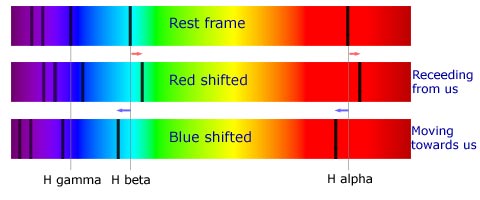
Fig 5 : Red Shifted and Blue Shifted spectra compared to a spectrum in rest frame


The Doppler Effect in stellar spectra soon became an important tool to calculate velocities of stars and even galaxies on the cosmological scale. These calculations yielded precise velocities of stars in binary and more complicated star systems. The radial velocity method was used to detect and measure the wobbles produced in a star because of the gravitational tugging of a potential exoplanet. The velocities allowed estimating masses of star in star systems by simple mechanical calculations.


In the 20th century, developments in Quantum Mechanics and Thermodynamics found its applications in the field of Astronomy and Astrophysics. In Thermodynamics, one of the main concerns is the ways in which heat energy can be absorbed or transmitted by a body. You must have noticed whenever you bring your hand close to a heated pan or a piece of metal; you could feel the heat without touching the pan. This is because when the pan gets hot, its molecules and atoms start to jiggle around randomly and emit radiations which are nothing but electromagnetic radiations mostly of the infrared and microwave regions. These radiations are then incident on the atoms of your skin, which absorb them and get excited in turn, producing heat. The amount of heat radiation that a body can absorb depends mostly on its material and shape. In thermodynamics, one imagines an ideal body which could absorb all of radiation incident on it. Such a body is called as “Blackbody”. Although, no object could be regarded completely as a “blackbody”, there are some cases in which an object could be approximated pretty closely as a blackbody. Experiments were conducted with such blackbodies to study their nature and as a result various laws were discovered. The most important of them was the – Wien’s Displacement Law. The law states that the wavelength of the radiation of maximum intensity emitted by a body is inversely proportional to its temperature. A body generally emits electromagnetic radiations in all wavelengths at different intensities. Wien’s law relates the wavelength of this radiation to the temperature of the body. This relation is such that the wavelength of emission is inversely proportional to the body temperature, or the frequency of emitted radiation is directly proportional to the temperature. Consequently, a hot body will emit radiation of higher frequency than that emitted by a cooler one. So, bodies at higher temperatures will glow with a bluish hue and those at cooler temperatures will appear reddish. Alternatively, this result can also be explained by the energy – frequency relation given by Planck, which we saw earlier. Bodies at higher temperatures have more heat energy and hence will glow at higher frequencies and vice versa.

In spectroscopy, this thermodynamic relation was used to estimate the temperature of stars and celestial bodies which emit radiation. The relative brightness of the different colors in a stellar spectrum is compared, and the color with greatest brightness (intensity) is used to calculate the temperature of a star. If the maximum intensity is more towards the bluer side of spectrum, then the star itself appears bluish and has a very high temperature. Similarly, if the maximum intensity is towards the redder side of spectrum then the star has a low temperature. Therefore, a common observation in Astronomy was that red stars are cooler than blue stars. On the basis of their color and respective temperatures, the stars can be classified into different types. This is known as the Harvard Spectral Classification and all the stars are roughly divided into 7 broad categories from hottest to coolest as : O, B, A, F, G, K, M. The stars from O to F are blue or bluish-white in appearance and have a hot temperature of 6000 to above 25,000 kelvins.  The stars from G to M are yellowish white to red in appearance and have a relatively cooler temperature of 3000 to 5000 kelvins. Our Sun belongs to the G type and glows in white color with an intermediate temperature. It appears yellow – orange from Earth due to atmospheric scattering effects.

Fig 6: Spectral curve peak of different stars according to their temperature


What appeared to be a simple result of placing a glass object in the path of light rays was employed so extensively in the domains of Astronomy. A simple glass prism enabled us to calculate the chemical and physical properties of stars at vast distances. Perhaps, one could take this as a prime example for the tremendous potential of seemingly trivial discoveries in Physics. The current state of Modern Physics is often questioned for its benefaction to human society. Nevertheless, I believe that with time and progress, the importance of gravitational waves, particle accelerators, and black holes will soon be realized similar to the importance of the rainbow obtained from a prism.


-        Thank you.


Thursday, February 17, 2022

Lagrangian and Hamiltonian Mechanics : An Unseen Side of Classical Physics

Ever since, school and high-school till the early undergraduate years, students are rigorously made accustomed to the world of Newtonian Mechanics. In fact, those studying in other fields than the Physical Sciences may never see the world beyond this Newtonian Framework of Classical Physics. All of us have been taught and told to remember by heart the three most important laws of Mechanics - Newton's Laws of Motion. These laws provide an intuitive insight to how physical systems evolve and behave with time. They lay down the mathematical foundations to compute the trajectory of any object i.e. its motion through space as time passes, mainly - the Newton's Second Law of Motion which states that the magnitude of an external force experienced by any body is proportional to how much it accelerates. The proportionality constant here is the "inertial mass" of that body. Alternatively, one can say in the language of Calculus that the external force experienced by a body is equal to the product of its mass(m) and the derivative (rate of change) of its velocity with respect to time (dv/dt). But, velocity of that body is the rate of change of its displacement, or the derivative of displacement (x) with respect to time. By this definition, acceleration can be represented by the second derivative of position with respect to time, or - "The rate of change of  the rate of change of position". The first one sounds better.  This renders Newton's Second Law of Motion into a "Differential Equation" which can be solved by special methods. By solving this differential equation, the final solution is obtained in the form of a function x(t). Mapping this function against the time variable on a graph, shows visually how any physical system behaves with time and also predict its future states.

This formulation of Classical Physics works just fine in most scenarios and physical systems. However, there are some systems where applying Newton's formalism becomes too messy and rather inconvenient. Situations such as a double pendulum, a pendulum fixed to a moving support, an object sliding on an inclined plane which itself is moving, etc. are some examples where Newtonian Mechanics isn't a viable option. Such systems either comprise of too many coordinates and independent parameters or too many external forces or both, that it is extremely hard to keep track of individual forces and their effect on other forces. Life would get easier, if somehow it became possible to find our way around this problem by using some other physical quantity to predict the behavior of such dynamic systems. This other way around to the problem manifested itself in the form of Hamiltonian and Lagrangian Mechanics. The formalism was developed by Joseph-Louis Lagrange and Sir William Hamiltonian in the 18th and 19th centuries respectively. 

The core principle behind Lagrangian and Hamiltonian Mechanics is the mathematical concept of Calculus of Variations. The ordinary Calculus most of us are familiar with involves "functions" which is a one to one relation between two real number sets. They can be regarded as machines that take one real number as an input upon which certain mathematical operations act and spew out another or same number as an output. Calculus of Variations on the other hand deals with "Functionals" - they are machines that take an entire function as an input and yield a number as an output. The task in hand is then to minimize these "functionals" subject to certain constraints. A main goal of this article is not to hinge on the abstract mathematics but try to provide an intuition for the idea behind that mathematics. A central quantity of Lagrangian Mechanics is the "Lagrangian Function (L)" or simply the Lagrangian. This Lagrangian is equal to the difference between the Kinetic Energy (T) (yes, Kinetic Energy is represented by T) and the Potential Energy (V).

L = T - V   -- (1)

The integral of this Lagrangian in the limits of the starting time (t1) and ending time (t2) is equal to a quantity called as "Action". This quantity is the example of a "functional" which takes the Lagrangian function as input and gives a number. But where are we headed to by introducing such weird names for some mere mathematical operations on already existing quantities like Kinetic and Potential Energy from Newtonian Physics? Most standard introductory texts on the subject skip this intuition part and dive directly into the complicated derivations of mathematics. What we have here is the Lagrangian Function, which is the difference in Kinetic Energy and Potential Energy. The Kinetic Energy of a system is a direct representation of how much "motion" is happening in that system, while Potential Energy represents how much motion "could" happen in that system but isn't happening. A stretched rubber band or a ball placed on a height packs in more Potential Energy, but if you let go of the rubber band or allow the ball to fall from that height, this Potential Energy is converted to Kinetic Energy. From equation 1 we can infer that, if a system has greater Kinetic Energy its Lagrangian is greater and so the system is more dynamic, more "lively". Conversely, if its Potential Energy is greater then the system is less dynamic, less "lively". The integral (or summation) of this "liveliness"  of a system over some time period gives the "Action" of that system. 

Now, the main principle of Lagrangian Mechanics which is also known as the "Principle of Least Action" says that - the path followed by a system through space between any initial and final time is such that its Action is minimized or remains least. This implies that a system always goes through that path for which its Action is minimal or for which it's "liveliness" or "dynamicity" is least . 


Above diagram visualizes a few of all the possible paths between two points that a system can take while travelling through space and time. There is an infinite number of all such bizarre paths that one can draw. With each of such paths (represented by the different colours) a number is associated with them, which was introduced earlier as "Action". The system starts at point A at time t1 and reaches at point B at time t2.The "Action" of each individual paths between these points is then determined by the different Lagrangians of those paths. Some paths may have a greater Lagrangian value and thus the system going through such paths is more lively and in motion, while some paths have lesser overall Lagrangian and the system is less dynamic for such paths. Out of the seemingly many infinite paths, the Principle of Least Action tells us that this system will take that path for which the "Action' associated with it is least. It is as if there is an algorithm that already dictates what path a system shall choose.

Oddly enough what it means is that Nature is a bit lazy! Initially, this result was somehow attributed to the assertion that God chooses such a path for a system for which the action is minimum. The sense behind this statement is quite pragmatic. If I were to govern the motion of all objects in this Universe, I would most certainly prefer objects to not bounce around much without any reason. Either way, the principle did confirm with observed motions of dynamic bodies. Every spontaneous process in nature minimizes the Action of that process. The most important application of this principle was to explain the behavior of light. Fermat's principle which was a modified analog of Hamiltonian and Lagrangian Mechanics accounted for the path taken by any light ray, which is such that the time taken to travel between two points is minimized. By working through the Principle of Least Action, one arrives at the Euler - Lagrange Equation - An epitome of Lagrangian Mechanics. This equation represents Lagrangian Mechanics in the same way that F = ma represents Newtonian Mechanics. In fact, it is very much possible to extract the mathematical statement of Newton's Second Law from the Principle of Least Action and Euler - Lagrange Equation, even if the two appear distinct.


The above equation is the Euler - Lagrange Equation. It can be classified as a second order differential equation. The letter q in it represents the "generalized coordinate". Here generalized meaning that the coordinate can refer to anything. For example, one can use cartesian coordinates in case of linear motion, or polar coordinates for a pendulum or angular motion, etc. The fancy L like letter, is the symbolic representation of our Lagrangian Function given by :


Lagrangian is a function of the generalized coordinate q and the velocity of system, which is represented by the second q with a dot overhead. A convention in Physics is to denote the rate of change of a quantity(derivative) with respect to time by placing a dot over it. In the 19th century, Hamilton developed a similar modified version of Lagrangian Mechanics that became known as Hamiltonian Mechanics. Just like the Lagrangian, his version involves a "Hamiltonian" which is equal to the sum of Kinetic and Potential Energies of a system. 

H = T + V   --(4)

The Hamiltonian Equations of motion are :


Here q is the generalized coordinate and p is the momentum of system.


Lagrangian Mechanics along with Hamiltonian Mechanics proved crucial in supplementing the mathematics of modern Physics. The Hamiltonian became an operator which is extensively used in Schrodinger's Equation. The Principle of Least Action along with Lagrangian Mechanics was employed by Richard Feynman in his Path Integral Formulation of Quantum Physics. The Lagrangian is even found in Quantum Field Theory - one of the most precise theory ever discovered by mankind. Unfortunately, Lagrangian and Hamiltonian Mechanics wasn't able to gain the fame and recognition that Newton's Laws did in everyday lives. This could be explained perhaps by the fact that a physical intuition for these formulations is hard to explain. But, sometimes the physical intuition behind a theory isn't the most significant aspect as long as it works consistently, which is the case for Lagrange and Hamilton's theories.


- Thank You.


Wednesday, November 17, 2021

General Relativity : Background and Principles

 The Special Theory of Relativity was introduced to the world by Albert Einstein in 1905. An enhanced and sophisticated version of Galileo's Relativity, this theory managed to be compatible with the new findings of electromagnetic radiations of the early 20th century. There was nothing but triumph and glory to it. But every new theoretical assertion in Physics is bound to be met by skepticism and ultimately, Special Relativity was not spared. The biggest and probably the most troublesome loophole in this theory was a necessity of inertial reference frames only i.e. reference frames (or observers) executing a constant linear motion. The moment one introduces even the tiniest of acceleration for any of the reference frames, the symmetry falls apart. In fact, the basic Principle of Relativity no longer holds. If one of the concerning observers is accelerating, then one can assign almost an absolute meaning to this acceleration. Einstein was starting to get annoyed by this. For, it was a subtle yet very crucial down point to his theory.

The breaking of symmetry marked a transition from an ideal world of inertial frames to a very realistic Universe of non-inertial frames existing almost everywhere. A car driver after pressing down on his accelerator, accelerates forward and imparts an opposite force on him and the passengers. Let the same car traverse a curved road and it accelerates under the influence of a centripetal force, while the passengers feel a fictional centrifugal force. It is implausible to try and use relativistic equations here because observers outside the car as well as inside shall observe the same forces. There is no equivalence of inertial frames as implied by Principle of Relativity because there are no inertial frames in the first place. Our cosmos is filled completely with matter and energy distributed in a near-isotropic fashion. The gravitational effects owing to this matter produce acceleration for any object moving through it's area of influence also known as the gravitational field. These gravitational fields permeate everywhere and must give rise to non-inertial frames nearly everywhere. Furthermore, the accepted theory of Newtonian gravitation at the time was based on instantaneous action at a distance. Newton regarded gravity as a force that always exists between any two bodies of mass. This gravitational force was believed to be instantaneous and thus travel faster than light to act upon any body. This was indeed conflicting with one of the fundamental postulates of Special Relativity that nothing can travel faster than the speed of light.

Einstein's elegant theory was on dangerous grounds. Until, he was struck by what he recalled as "the happiest thought of my life" - In 1907, when sitting at his desk in the patent office, Einstein imagined a man falling freely from the roof his house. [1] How peculiar for the ordinary to title this as one's happiest thought! Yet, for a physicist bothered since two years, this elation was quite obvious. The unfortunate man who falls from the roof of his house should momentarily experience weightlessness till he impacts with the ground. This is because the man is falling freely without the presence of any material object upon which he can exert his weight. Hence, everything which free falls with him should also appear weightless to him. Take a weight scale, glue it to his feet and toss him off the roof again with a trampoline on the ground for the sake of humanity. The man will see a zero reading on the weight scale throughout his entire free fall trajectory. The weird sensation in your stomach when you are on a roller coaster ride and it suddenly plunges down is the sensation of sudden weightlessness. Another experiment which you could try at home is to take a plastic bottle with a few holes pierced at the bottom and fill it with water. Hold the bottle up to a certain height. Initially, the water is dripping through the holes but as soon as you let go of it, you shall observe that the water no longer drips from those holes. There is no weight to the bottle as well as the water inside it.[2]

Einstein discovered the key symmetry to retain the basic Principle of Relativity. Every object in a free fall appears weightless to any other object falling with it. Thus, every observer in a freely falling reference frame should appear to be floating around as if there are no gravitational forces.[3]  If the reference frame was of an observer inside a completely closed cabin in free fall, there is no way by which he could tell if the cabin is floating in free space in the absence of any external forces or falling under the influence of Earth's gravity.  Consequently, if an observer is accelerating in free space inside a closed cabin then he shall feel a force pulling him in the opposite direction. This is because the floor of the cabin pushes against his feet and he feels a reaction force in the opposite direction owing to Newton's Third Law of Motion. Say, the cabin has an upward acceleration exactly equal to the value of g on Earth i.e. 9.8 m/s^2. There would be no way for the observer inside the cabin to tell apart if the cabin is sitting in the gravitational field of Earth or accelerating in free space. Some noticeable daily life examples are the g-forces experienced in a roller coaster when it suddenly accelerates up, or by a jet-fighter pilot pulling extreme maneuvers. The magnitude of these are often portrayed by 4g,7g, etc. which implies the gravitational forces experienced are 4 or 7 times the gravitational force of Earth. At high enough g-forces, the person's weight increases upto 9 times the original weight. The blood from his brain is pulled down due to these forces and he/she passes out momentarily. This resembles the state of two inertial frames moving relative to each other. There is no way for them to tell which one's moving. In other words, both reference frames are equal and this constituted the first postulate of the equivalence of inertial frames in Special Relativity. For an observer inside a completely closed cabin moving with a constant linear velocity, there would be no way for him to determine whether he's at rest or in motion Similarly, the equivalence of an inertial reference frame in the absence of any forces and an inertial frame in free fall or the equivalence of acceleration of a reference frame in free space and acceleration due to gravitational field constituted the first ever principle of General Relativity. This principle became widely known as the "Equivalence principle". It states that in a small enough region, gravitational and inertial forces are often of the same nature and indistinguishable. 

The constraint of a "small enough region" or in other words a 'local' region is introduced to account for the tidal forces. A general observation regarding any object under the gravitational influence of our Earth for example is that the object always falls towards the center of mass or "barycenter" of the Earth. Due to this, two objects in a free fall won't fall parallel towards the surface of Earth. They would converge towards a common point. If the two objects are inside a closed cabin in free fall, then it shall appear as if they are moving (accelerating) towards each other. This renders the cabin as a non-inertial reference frame and violates the Equivalence principle. Therefore, the equivalence principle requires a local or small enough region of a reference frame.

In this way, Special Relativity was retained once again. Summarizing everything :  a body freely falling in a gravitational field is equivalent to a body moving with constant velocity in deep space (weak equivalence principle) and a body sitting in a gravitational field is equivalent to a body uniformly accelerating in deep space (strong equivalence principle). It was also known that the acceleration with which any object falls in a gravitational field is independent of its mass. If this wasn't true then objects of different mass inside a freely falling reference frame would accelerate with different magnitudes. Such a reference frame would then be deemed as non-inertial. From all these observations, Einstein was able to infer that gravity is not a consequence of the material composition of an object but rather the nature of the spacetime around it. In formal language, a metric theory of gravity was born which was compatible with Special Relativity and its postulates.

The consequences of this theory were immediately recognized. The most prominent consequence being the effect of gravity on electromagnetic radiations. Earlier, light was known to be composed of massless particles. Newtonian Gravity asserted that the attractive forces between any two material bodies due to gravity is directly dependent on their mass. Thus, it was believed that light and particularly electromagnetic radiations shall remain unaffected by any gravitational influence. But, General Relativity suggested a different picture. Imagine, a completely enclosed cabin fitted with tremendously powerful rocket engines. Inside the cabin is an observer holding a light torch parallel to the cabin floor and pointed at one of the walls of that cabin. Now, the rocket engines are fired, imparting a large vertical acceleration to the cabin. As the cabin continues to accelerate up, this observer turns on the light torch. We ask ourselves the following question - "Where do we observe the light to be incident on the cabin wall?". At first glance, one may think that the light spot should be visible exactly in the direction where the torch is pointed . A little investigation reveals this to be untrue. There are two well established facts at our disposal - first the cabin has a large acceleration upwards and secondly (most importantly) , light always travels at a constant speed.  Therefore, as light leaves the torch and starts travelling towards the wall, the spot at which the torch was pointed moves up ever so slightly because the cabin is accelerating. By the time, the light approaches the wall, the original spot A would have moved up by a significant extent and the light will fall upon a different lower spot B. This is the most intuitive outcome provided the two given facts. If the cabin were not accelerating, then the light ray would have fallen straight on spot A, or if the speed of light were infinite then the ray would have instantaneously reached the wall. Neither is the case, and hence the light ray rather traces a parabolic curve throughout its journey. Just like water flowing out of a garden hose. The water moves straight horizontally with a constant velocity but gravity causes it to trace a parabolic curve. Similarly, the light moves straight horizontally with a constant speed but the acceleration causes it to trace a parabola. But behold! The Strong Equivalence Principle states that one cannot distinguish by any means between a constantly accelerating frame (cabin) and a frame (cabin) sitting in a gravitational field. If light bends down in an upwards accelerating cabin then it should also bend in the gravitational field of a massive body. In fact, our observer inside the cabin will declare and quite rightly that his cabin is sitting inside a gravitational field which pulls down the light ray coming out from his torch. Like, water being pulled down from a garden hose.


The bending of light near a massive body is termed as - "Gravitational Lensing"[4] and was one of the first experimental confirmations of Einstein's Theory of Relativity. Einstein suggested that by this phenomenon, it might be possible for light to bend when it passes close enough to the Sun. It may be possible that those stars which are usually behind the Sun, can be observed from Earth by this bending effect. 


However, the light coming from Sun during daytime is intense enough to obscure any feeble light emitted by the stars behind it. Except, during a total solar eclipse, when most of the solar disk is covered by Moon. This creates a time window of sufficient darkness, around the Sun enabling any stars near it to be visible through a telescope. An expedition of astronomers was summoned to observe the solar eclipse of 29 May 1919. It consisted of two teams headed towards two different locations. One of the teams stationed at Principe in West Africa comprised of the famous astronomer Sir Arthur Eddington.[5] Their motive was to observe the gravitational lensing effect predicted by Einstein's Relativity. The results obviously were in favour of Einstein. General Relativity passed its experimental test with flying colours. In a dinner held by the Royal Astronomical Society, Sir Arthur Eddington beautifully and quite comically, described his results in poetic verses - 

"Oh leave the Wise our measures to collate. One thing at least is certain, light has weight. One thing is certain and the rest debate. Light rays ,when near the Sun, do not go straight."

The results were considered as a breakthrough in the history of Physics and made it to the frontpage of major newspapers. The news also created a significant impact on the popularization of Physics in the common household. Einstein gained fame and celebrity status as people started to know him as the physicist who discovered a new theory of gravity after Newton. Many experimental confirmations followed thereafter which included gravitational time dilation, the precession of the perihelion of mercury, black holes, gravitational waves and so on. Although, the period of almost ten years between the discovery of Equivalence Principle in 1907 till the finally correct version of General Relativity published in 1916 was a gruesome struggle for Einstein. The struggle was to formulate a precise mathematical model to encompass his theoretical principles. The behavior of spacetime and objects moving through it is accurately described by Differential Geometry i.e. the geometry of curved surfaces. With the help of his friends and colleagues, Einstein learnt this exceedingly difficult field of mathematics and managed to formulate a unified tensor equation known as the "Einstein Field Equations". Even today the equations are incredibly complex to solve and astronomers adhere to the simple Newtonian Law of Gravitation for majority of astronomical calculations. Nevertheless, the impact of General Relativity on modern physics was unprecedented. In the next part of this blog, I shall make a mediocre attempt to touch the mathematics of Differential Geometry and Tensor Calculus with its applications in General Relativity.


- Thank You.


References -

[1] https://einsteinpapers.press.princeton.edu/vol7-trans/151

[2] https://www.youtube.com/watch?v=0jjFjC30-4A&t=257s

[3] https://www.youtube.com/watch?v=FO_Ox_dH0M8

[4] https://hubblesite.org/contents/articles/gravitational-lensing

[5] https://www.nature.com/articles/d41586-019-01172-z